Research3 min read
From Firm-Centric to Societal: How Innovation and Knowledge Management Research Changed in 20 Years
Our new article in the European Journal of Innovation Management maps 345 papers published between 2003 and 2025. The field still revolves around knowledge and innovation, but sustainability and societal impact have moved from the margins to the centre.
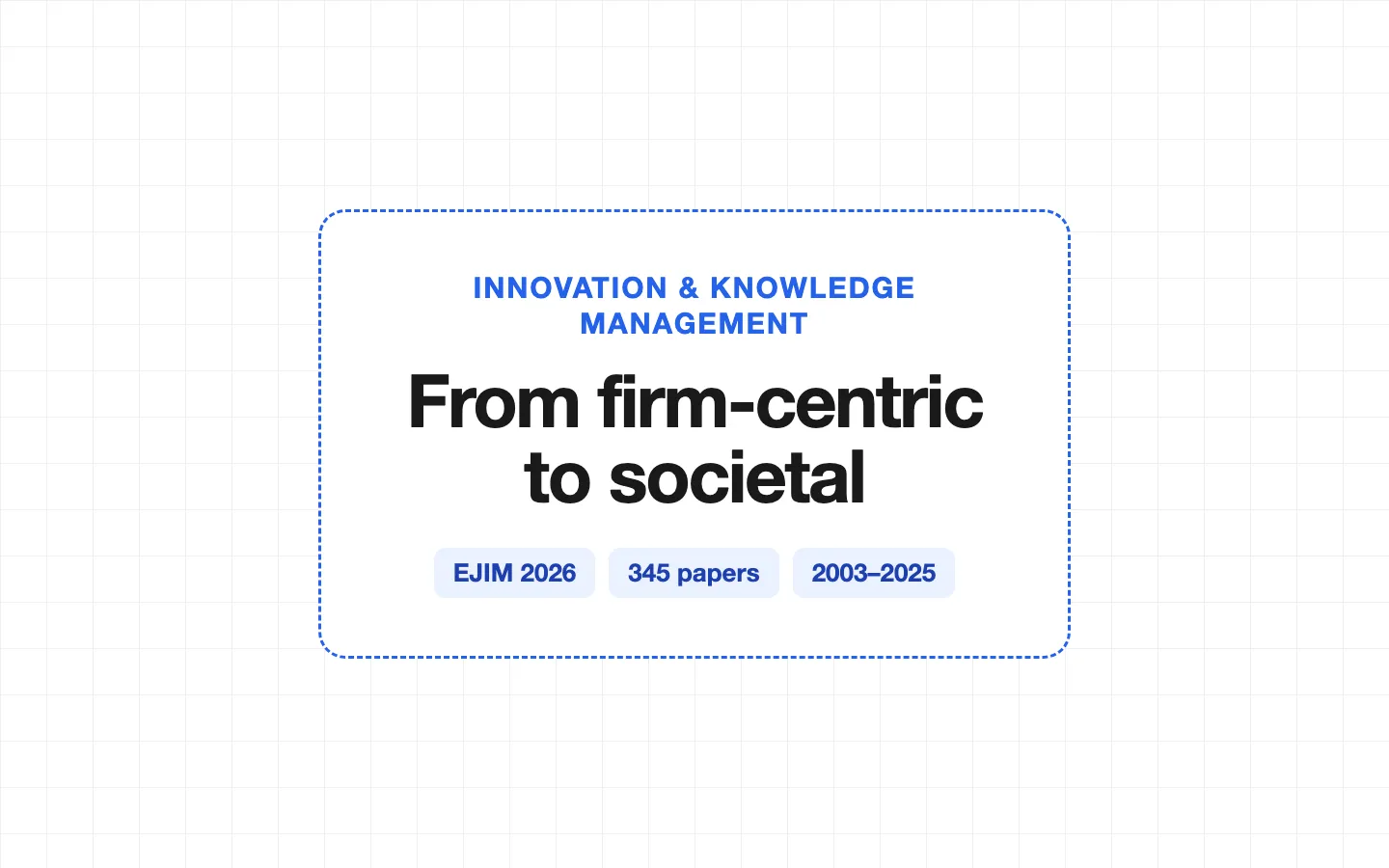
We have a new article out. “From firm-centric to societal: the conceptual evolution of innovation and knowledge management research (2003–2025)” has just been published online in the European Journal of Innovation Management (Emerald). I co-authored it with María Teresa de Val Núñez and José Andrés Gómez Gandía, from the Universidad de Alcalá.
The question behind it is simple: what has the research on innovation and knowledge management actually been about over the last two decades, and how has that changed?
What we did
We built a corpus of 345 peer-reviewed articles from Scopus, published between 2003 and 2025, and studied it with two families of bibliometric tools:
- Performance analysis: how much is published, who collaborates with whom and how the field is cited.
- Science mapping: keyword co-occurrence and co-citation networks, thematic evolution across periods, and strategic maps that place each theme by how central and how developed it is.
Together, they show both the intellectual structure of the field and how its themes have moved over time.
What we found
1. A growing and international field. Scientific production has grown steadily, international collaboration is strong, and the citation profile confirms that the field matters to the wider literature.
2. The core has not moved. Knowledge management and innovation are still the conceptual centre of the domain. The field has not lost its identity.
3. What surrounds the core has changed. Sustainability and societal impact started as peripheral topics. Today they are organising principles built into the structure of the field, in line with global sustainability agendas. This is the shift in the title: from a logic focused on the firm to one focused on society.
4. The methods are diversifying. Machine learning and Bayesian inference are starting to appear alongside the established analytical frameworks.
Why it matters
The field is not just getting bigger. It is being reoriented around societal challenges, sustainability and more plural methods. For researchers, that gives a structured map of where the field comes from and where the open questions are. For organisations, it is a reminder that managing knowledge and innovation is no longer only about competitive advantage inside the firm: it is increasingly about how firms contribute to resilient, knowledge-driven societies.
It also connects with the rest of my work. My doctoral research looks at how generative AI changes the way organisations decide and work, and seeing machine learning enter the toolkit of a field built on knowledge management is part of the same story.
Read the article
- Article: de Val Núñez, M. T., Luengo Vera, C. and Gómez Gandía, J. A. (2026). From firm-centric to societal: the conceptual evolution of innovation and knowledge management research (2003–2025). European Journal of Innovation Management, 1–28.
- DOI: 10.1108/EJIM-06-2026-0869
- All my publications are on the Research page.
Thanks to my co-authors, and to the reviewers and editors at the European Journal of Innovation Management.